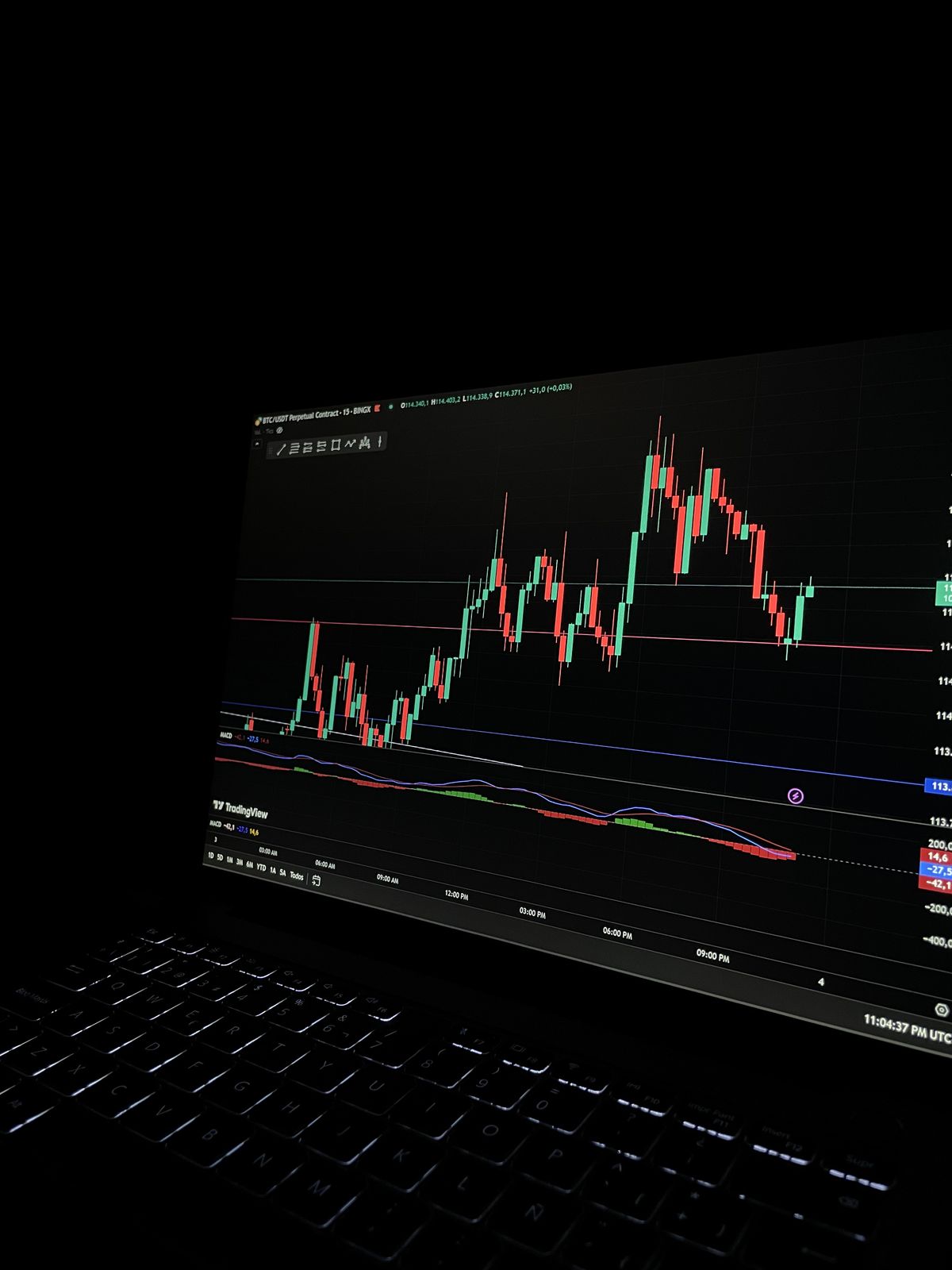
There is an old saying on Wall Street: the trend is your friend. Momentum trading is built entirely around that idea. When an asset is moving strongly in one direction — driven by earnings beats, macro data, institutional flows, or broad market sentiment — momentum strategies look to enter in the direction of that move and ride it until the trend shows signs of exhaustion. Automating this process with a trading bot removes hesitation, enforces consistency, and lets you capture trend-following opportunities across multiple assets simultaneously, even when you are not watching the screen. This guide explains how momentum trading bots work, the strategies behind them, and how to configure one that holds up in live markets.
What Is Momentum Trading?
Momentum trading is the practice of buying assets that are moving up and selling or shorting assets that are moving down, based on the belief that strong price moves tend to continue in the same direction for a period of time before reversing. Unlike mean reversion — which bets on prices returning to their average — momentum trading bets on continuation. The academic evidence behind momentum is strong. Research going back decades across equities, commodities, currencies, and crypto consistently shows that recent winners tend to keep outperforming and recent losers tend to keep underperforming over medium-term time horizons. This is the foundation that momentum bots are built on.
How Does a Momentum Trading Bot Work?
A momentum bot continuously scans one or more assets for signals indicating a strong directional move is underway. When those signals align, the bot enters a position in the direction of the move. It then holds the position as long as momentum indicators confirm the trend is intact, and exits when momentum begins to fade or a predefined target or stop is hit. The entire process is rule-based and automatic — no discretionary judgment required once the strategy is configured and live.
Common Indicators Used by Momentum Bots
Moving Average Crossovers are one of the most widely used momentum signals. When a shorter-term moving average — such as the 20-day — crosses above a longer-term moving average — such as the 50-day — it signals upward momentum. The bot enters long. When the shorter MA crosses back below, the bot exits or reverses. The MACD (Moving Average Convergence Divergence) measures the relationship between two exponential moving averages and generates crossover signals that indicate momentum shifts. The ADX (Average Directional Index) measures the strength of a trend without indicating direction — a reading above 25 generally confirms a trend is strong enough to trade with a momentum strategy. Rate of Change (ROC) calculates how much an asset's price has changed over a defined lookback period, giving a direct measure of momentum velocity. Breakout signals trigger entries when price moves decisively above a recent high or below a recent low, suggesting institutional participation and a likely continuation move.
Types of Momentum Bot Strategies
1. Trend-Following Momentum Bots
These bots identify an established trend using moving averages or ADX and enter in the direction of that trend. They typically hold positions for days to weeks, making them suited to daily or four-hour chart timeframes. The advantage is that a single well-timed trend trade can generate outsized returns relative to the risk taken. The challenge is that trend-following bots have lower win rates — many small losses are offset by a handful of large winning trades. Traders must have the discipline to let winners run and cut losers quickly.
2. Breakout Momentum Bots
Breakout bots monitor key price levels — previous highs, consolidation zones, round numbers — and enter automatically when price breaks through with significant volume or volatility. Breakouts often signal the beginning of a new trend phase, making them powerful entry triggers for momentum strategies. False breakouts are the main risk — price briefly clears a level and then reverses. Volume confirmation filters and volatility-based entries help reduce false breakout entries.
3. Cross-Sectional Momentum Bots
Rather than trading a single asset, cross-sectional momentum bots rank a universe of assets by their recent performance and go long the top performers while shorting the bottom performers. This approach — popular with quantitative hedge funds — is market-neutral and profits from the relative performance spread rather than absolute direction. For retail traders, simplified versions can be built on platforms that support multi-asset scanning and automated portfolio rebalancing. For more on multi-asset automation, see our guide on 10 Best Trading Bot Strategies.
When Momentum Bots Work Best
Momentum strategies perform best during trending market environments — sustained bull markets, sector rotations, post-earnings moves, and macro-driven currency trends. They also work well in periods of high volatility when directional moves are sharp and sustained. Markets following major central bank announcements, economic data releases, or geopolitical developments often produce clean momentum setups that automated bots can exploit efficiently. The best trading bots for momentum are designed to identify high-quality trend conditions and avoid trading in choppy, low-conviction environments.
When Momentum Bots Struggle
The biggest enemy of a momentum bot is a range-bound, choppy market. When price oscillates without establishing a clear direction, moving average crossovers generate frequent false signals, and breakout entries quickly reverse. This leads to a string of small losses that can erode capital rapidly. A volatility or trend-strength filter — such as only trading when the ADX is above 25 or when the ATR (Average True Range) exceeds a minimum threshold — helps the bot step aside during low-quality market conditions. Without such filters, momentum bots can become their own worst enemy in sideways markets.
Risk Management for Momentum Bots
Use Trailing Stop-Losses
Because momentum trades are designed to capture extended moves, a fixed stop-loss set too tight will frequently exit the trade before the trend fully develops. Trailing stops — which move upward as the trade gains — allow winners to run while protecting profits if the trend reverses. A common approach is to trail the stop below the most recent swing low on the chart timeframe being traded.
Define Maximum Holding Periods
Momentum does not last indefinitely. Setting a maximum holding period — for example, automatically exiting any open position after 10 trading days regardless of profit or loss — prevents the bot from holding stale positions in markets where the original momentum thesis has expired.
Limit Correlated Positions
If a momentum bot is scanning multiple assets simultaneously, it can easily enter positions in several assets that are all responding to the same macro driver. If that driver reverses, all positions will lose at once. Limiting the number of highly correlated positions open at any time reduces portfolio-level concentration risk.
Related Reading
• Mean Reversion Trading Bots: How They Work and When to Use Them
• How to Optimize a Trading Bot Strategy Without Over-Fitting
• AI Trading Bot Risk Management: The Complete Guide
• How to Backtest a Trading Strategy
Momentum vs. Mean Reversion: Which Should You Automate?
Momentum and mean reversion are complementary strategies that thrive in opposite market environments. Momentum bots excel when markets are trending; mean reversion bots excel when markets are ranging. Many professional automated traders run both in parallel, allowing the two approaches to balance each other across different market regimes. If you are just getting started with a single strategy, the right choice depends on your preferred holding period, risk tolerance, and the primary asset class you trade. For a detailed comparison of the two approaches, see our guide on Mean Reversion Trading Bots.
Take our Free Trading Bot Match Quiz
Not sure which trading bot strategy is right for you? Take our free Trading Bot Match Quiz and get a personalized recommendation based on your budget, goals, and risk tolerance in under 60 seconds. We'll also send you a free e-book with honest reviews, performance stats, and red flags to avoid in the trading bot world. Whether you're looking for a momentum setup, a mean reversion system, or something in between, this guide helps you make the most informed choice. Click here to take the quiz and get your free report.
Related Reading
• 5 Best Automated Trading Platforms
• How to Build a Trading Bot: A Step-by-Step Guide
• Do AI Trading Bots Work?
• 7 Bot Trading Risks, and How to Avoid Them